



A Parent’s Book Review: What’s Math Got to Do With it
Many parents can vividly recall their own experiences with math in school. For some, math was a subject of confidence and curiosity — but for many it was associated with anxiety, memorization, and the feeling that some people are simply “good at math” while others are not. As we watch our children begin their own math journeys, it’s natural to wonder: Can our children learn differently and experience math with curiosity, confidence, and joy?
That question is at the heart of Greene Towne parent Jess Rice’s book review of What’s Math Got to Do With It? by Stanford professor Jo Boaler, a leading researcher in math education. Boaler challenges many of the assumptions that have shaped traditional math instruction and offers a hopeful vision of how children can thrive in mathematics. Jess reviewed the book as part of Greene Towne’s Parent Education Committee’s “You Don’t Have to Read the Book Book Club.”
Boaler’s ideas resonate strongly with the Montessori approach to math — and for good reason. Montessori math was designed over a century ago on the same foundational belief: that children learn mathematics most deeply when they can see, touch, and experience it first.
“Children aren’t taught to think mathematically — they’re given the conditions to discover that they already do.”
It actually begins before any numbers appear at all. In the toddler environment, the groundwork for mathematical thinking is laid through oral language, order, and functional independence. Children hear precise vocabulary as they sort, sequence, and care for their environment. The shelves, the materials, and the daily rhythms are all carefully prepared to support the child’s internal development — building classification systems, pattern recognition, and the earliest associations between sounds and symbols. Long before a child picks up a pencil, their mind is quietly organizing the world in mathematical ways.
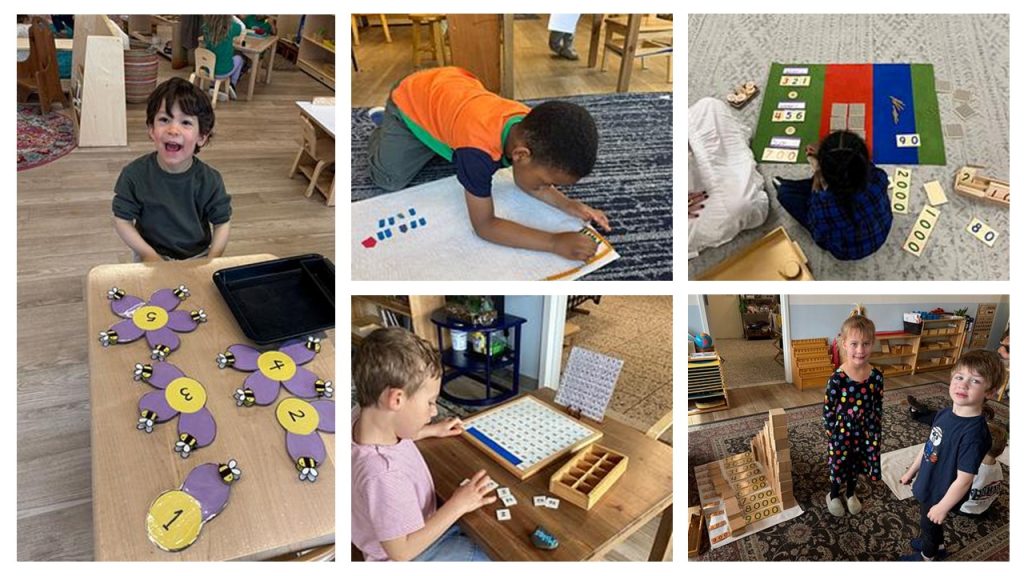
As children move into Primary, that foundation becomes explicit. In a Montessori classroom, your child isn’t just told that 1,000 is bigger than 10 — they feel the difference by holding the Golden Bead materials in their hands. They discover multiplication concepts through the Bead Chains and the Stamp Game, returning to these materials again and again as understanding deepens. This intentional journey — from concrete, hands-on exploration to pictorial understanding to abstract symbols — is at the heart of how Montessori math works at every level.
Importantly, correctness is not the point in these early years. Children are not asked to check their work or arrive at exact answers. The emphasis is on the process — on handling the materials, internalizing our base-ten system, and building a felt sense of place value through repeated, hands-on experience. Take the concept of exchanging: rather than learning a rule on paper, a child physically carries a ten-bar to the classroom “bank” and trades it for ten individual unit beads. They experience the equivalence in their hands and in their body. Exactness comes later. Understanding comes first. And this is just one example of many — Montessori math extends far beyond operations like addition, subtraction, multiplication, and division. Geometry, patterning, measurement, time, and data are all part of the landscape. At its core, Montessori’s approach honors what Maria Montessori called the mathematical mind — the natural human drive to order, classify, and make sense of the world. Children aren’t taught to think mathematically; they’re given the conditions to discover that they already do.
Montessori classrooms also emphasize:
- A concrete-to-abstract progression — beautiful, purposeful materials (like the Number Rods, Bead Frame, and Checker Board) give children a physical sense of mathematical ideas long before abstract symbols take over
- Exploration and discovery over rote memorization — children are invited to notice patterns, ask questions, and construct their own understanding through continued practice with materials
- Multiple pathways to solve problems — there is rarely just one “right way,” and children are encouraged to reason through challenges in ways that make sense to them
- A calm, pressure-free environment — math is not timed or tested for speed; it is not until the elementary years that children are guided to check their work, building genuine confidence along the way
- Real-world connections — from navigating city blocks to dividing a snack fairly among friends, math shows up everywhere children already live and move
In many ways, Montessori math teaching has been ahead of the curve for generations. What modern research — including Boaler’s work — now confirms as essential for deep learning, Montessori classrooms have been practicing all along.
Quick Reference Guide
- Boaler’s research and Montessori’s approach share the same belief: children learn math most deeply when they can see, touch, and experience it
- Math at GTMS is not about speed or correctness — it’s about building genuine understanding from the ground up
- Oral language is the foundation of mathematical thinking
- Order and functional independence build classification systems
- The prepared environment supports sound-to-symbol associations before numbers ever appear
- Golden Bead materials let children feel the difference between 10 and 1,000
- Bead Chains and Stamp Game introduce multiplication through hands-on discovery
- Children return to concrete materials repeatedly — the process matters more than the answer
- Exactness and checking work come in the elementary years, not before
- Example: exchanging is taught by physically trading a ten-bar for ten unit beads at the “bank”
- Goes beyond +, −, ×, ÷ — includes geometry, patterning, measurement, time, and data
- Honors the mathematical mind: the natural human drive to order and classify
- Multiple strategies encouraged; no single “right way”
- Connected to real life: city blocks, sharing snacks, daily routines
- Concrete-to-abstract progression — Number Rods, Bead Frame, Checker Board build physical understanding first
- Exploration over memorization — patterns, questions, continued practice with materials
- Multiple pathways — no single right way; children reason in ways that make sense to them
- Pressure-free environment — not timed or tested for speed; checking work comes in elementary years
- Real-world connections — math shows up everywhere children already live and move
- What modern research now confirms as essential, Montessori classrooms have been practicing for generations
- Boaler’s work and Montessori’s philosophy are not just compatible — they’re kindre